


 Home
Home Natural Language Automation Ppt Powerpoint Presentation Complete Deck
Our Natural Language Automation Ppt Powerpoint Presentation Complete Deck are topically designed to provide an attractive backdrop to any subject. Use them to look like a presentation pro.








-

- Google Slides is a new FREE Presentation software from Google.
- All our content is 100% compatible with Google Slides.
- Just download our designs, and upload them to Google Slides and they will work automatically.
- Amaze your audience with SlideGeeks and Google Slides.
-

Want Changes to This PPT Slide? Check out our Presentation Design Services
-

- WideScreen Aspect ratio is becoming a very popular format. When you download this product, the downloaded ZIP will contain this product in both standard and widescreen format.
-

- Some older products that we have may only be in standard format, but they can easily be converted to widescreen.
- To do this, please open the SlideGeeks product in Powerpoint, and go to
- Design ( On the top bar) -> Page Setup -> and select "On-screen Show (16:9)” in the drop down for "Slides Sized for".
- The slide or theme will change to widescreen, and all graphics will adjust automatically. You can similarly convert our content to any other desired screen aspect ratio.
Compatible With Google Slides

Get This In WideScreen
You must be logged in to download this presentation.


Do you want to remove this product from your favourites?
 Impress Your
 Audience
 100%
100% Editable
Compatible with Google Slides
Features of these PowerPoint presentation slides:
People who downloaded this PowerPoint presentation also viewed the following :
Related Products




Natural Language Automation Ppt Powerpoint Presentation Complete Deck with all 98 slides:
Use our Natural Language Automation Ppt Powerpoint Presentation Complete Deck to effectively help you save your valuable time. They are readymade to fit into any presentation structure.
Content of this Powerpoint Presentation
Slide 1: This slide introduces Natural Language Automation. State your company name and begin.
Slide 2: This slide states Agenda of the presentation.
Slide 3: This slide shows Table of Content for the presentation.
Slide 4: This is another slide continuing Table of Content for the presentation.
Slide 5: This slide highlights title for topics that are to be covered next in the template.
Slide 6: This slide gives an overview of the Natural Language Generation system. The purpose of this slide is to showcase the various types, working steps, models and methodologies of NLG. It also includes the applications of NLG, covering analytics reporting, content automation, virtual assistants & chatbots and so on.
Slide 7: This slide illustrates the five main components of Natural Language Generation. The purpose of this slide is to showcase the different elements of NLG, including aggregation, referring expression generation, lexicalization, linguistic realization, and using discourse markers.
Slide 8: This slide outlines the main types of Natural Language Generation technology. The purpose of this slide is to showcase the primary forms of Natural Language Generation, including basic NLG, template-driven NLG, and advanced NLG.
Slide 9: This slide outlines the various variant of Natural Language Generation technology. The purpose of this slide is to showcase the suitability of templated NLG, intelligent NLG, and enterprise NLG tools functions. The functions include relevant, intuitive, and timely.
Slide 10: This slide represents the advantages of Natural Language Generation technology. The purpose of this slide is to showcase the pros of NLG, including saving human time and efforts, increasing content production, high-quality content, creating topical coverage, and personalized experiences.
Slide 11: This slide highlights title for topics that are to be covered next in the template.
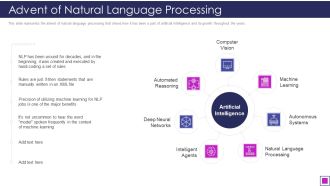
Slide 12: This slide gives an Introduction to Natural Language Processing technology. The purpose of this slide is to represent the NLP overview, its various techniques, working stages, and use cases in different domains, including translation applications, fake news detection, classifying emails, and so on.
Slide 13: This slide showcases the different phases of Natural Language Processing working. The purpose of this slide is to highlight the working stages of NLP, covering lexical analysis, syntax analysis, semantic analysis, discourse integration, and pragmatic analysis.
Slide 14: This slide outlines the syntax and semantic analysis techniques used in Natural Language Processing . The purpose of this slide is to showcase the various syntax and semantic analysis methods, including lemmatization, morphological segmentation, word segmentation, and so on.
Slide 15: This slide represents the advantages of Natural Language Processing to different organizations. The purpose of this slide is to showcase the various business pros of NLP, including better data analysis, saving time and money, streamlined processes, and improved customer experience.
Slide 16: This slide highlights title for topics that are to be covered next in the template.
Slide 17: This slide represents the comparison between Natural Language Processing , Natural Language Generation, and natural language understanding. The purpose of this slide is to highlight the main differences between NLP, NLG and NLU based on concept, information transformation, and so on.
Slide 18: This slide highlights title for topics that are to be covered next in the template.
Slide 19: This slide represents why Natural Language Generation is essential for businesses. This slide aims to showcase the various business benefits of Natural Language Generation, including speeding up the analysis process of critical data, improving customer relationships, and quickly responding to input on user behalf.
Slide 20: This slide represents the business processes that can benefit from Natural Language Generation. The purpose of this slide is to showcase the various departments that can take advantage of NLG, including marketing, customer experience, customer service, and digital adoption.
Slide 21: This slide represents the global market overview of the Natural Language Generation market. The purpose of this slide is to showcase the various aspects of the NLG market, including CAGR rate and market segmentation analysis. It also includes the growth drivers for the NLG market.
Slide 22: This slide highlights title for topics that are to be covered next in the template.
Slide 23: This slide represents the organizational benefits of Natural Language Generation systems in data analytics. The purpose of this slide is to showcase the various business benefits of NLG in analytics, including decision support, insight interpretation, and time-saving.
Slide 24: This slide outlines the role of Natural Language Generation in analytics platforms used by businesses. The purpose of this slide is to showcase why NLG is used in analytics platforms. It also includes the example of a BI tool that interprets the graphical representation reports into text form.
Slide 25: This slide highlights title for topics that are to be covered next in the template.
Slide 26: This slide outlines the overview of label efficiency in Natural Language Generation. The purpose of this slide is to showcase the various label efficiency categories, including transfer learning, few-shot methods, data augmentation, and unsupervised or semi-supervised learning.
Slide 27: This slide gives an overview of the parameter efficiency in Natural Language Generation. This slide aims to showcase the NLG model creation issues and two major solutions to overcome those issues. The solutions include model compression and parameter-efficient tuning.
Slide 28: This slide highlights the overview of compute efficiency in retrieval-augmented Natural Language Generation. The purpose of this slide is to give an overview of retrieval augmented NLG, the external knowledge retrieval equation and its components such as knowledge sources, retriever, and reader.
Slide 29: This slide highlights title for topics that are to be covered next in the template.
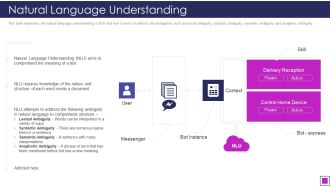
Slide 30: This slide outlines the computer science processes that enable Natural Language Generation. The purpose of this slide is to showcase the various computer science processes that help in the working of NLG, covering computational linguistics, NLP, and NLU.
Slide 31: This slide outlines the Working phases of Natural Language Generation technology. The purpose of this slide is to showcase the various phases of NLG working, including content analysis, data understanding, document structuring, sentence aggregation, grammar structuring, and language presentation.
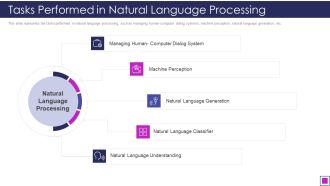
Slide 32: This slide describes the various tasks performed by the NLG system. The purpose of this slide is to showcase the different functions that NLG systems can perform, including machine translation, abstractive summarization, free-form question generation, data-to-text generation, dialogue generation, and image captioning.
Slide 33: This slide describes the main models and methodologies used in Natural Language Generation. The purpose of this slide is to showcase the primary models and methods of NLG, including the Markov chain, recurrent neural network, long short-term memory, and transformer.
Slide 34: This slide represents the primary models of transformers used in Natural Language Generation. The purpose of this slide is to showcase the various transformer models, including generative pre-trained transformers, bidirectional encoder representations from transformers, and XLNet.
Slide 35: This slide highlights title for topics that are to be covered next in the template.
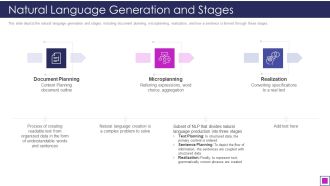
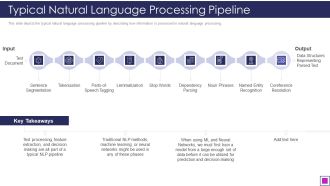
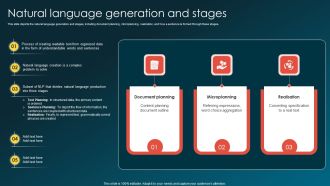
Slide 36: This slide outlines the overview of the pipeline steps of Natural Language Generation. The purpose of this slide is to showcase the various necessary pipeline steps of Natural Language Generation, including content determination and text planning, sentence planning, surface realization, and physical presentation.
Slide 37: This slide highlights title for topics that are to be covered next in the template.
Slide 38: This slide represents the leading tools that offer Natural Language Generation services. The purpose of this slide is to showcase the different software solutions that provide NLG services. The tools include Arria, AX Semantics, Amazon Polly, Automated Insights, Drift, Quill, and Clickvoyant.
Slide 39: This slide outlines the leading companies that provide Natural Language Generation tools and services. This slide aims to showcase the prominent NLG service providers, including OpenAI, Google, Hugging Face, Arria NLG, Narrative Science, Automated Insights, Yseop, an d Phrasee.
Slide 40: This slide highlights title for topics that are to be covered next in the template.
Slide 41: This slide represents the different needs of a Natural Language Generation system. The purpose of this slide is to showcase the various requirements for the NLG system, including primary data to be conveyed, the structure of content, the flow of sentences, choice of words, right referring expressions, and so on.
Slide 42: This slide gives an overview of features that an excellent Natural Language Generation system should have. The purpose of this slide is to showcase the various qualities that a good NLG system should incorporate, including providing relevant information, structured presentation, and so on.
Slide 43: This slide highlights title for topics that are to be covered next in the template.
Slide 44: This slide describes the essential steps organizations should take while using Natural Language Generation more efficiently. The purpose of this slide is to showcase the best practices that can help businesses to serve clients in a better way and transform business internally.
Slide 45: This slide represents the main steps to using Natural Language Generation in business operations. The purpose of this slide is to showcase the various measures organizations should consider while using NLG. These include determining the use case for basic NLG, looking at the data structure, and so on.
Slide 46: This slide represents how neural networks can be used to build Natural Language Generation models. The purpose of this slide is to showcase the use of neural networks in NLG models, such as Bidirectional Encoder Representations from Transformers (BERT) and Generative Pre-trained Transformer.
Slide 47: This slide outlines the main models used for data-efficient modeling in Natural Language Generation. The purpose of this slide is to represent the various models used for efficient data modeling in NLG, including the LSTM-based sequence-to-sequence model, joint training, dynamic data augmentation, and so on.
Slide 48: This slide outlines the bucketing techniques used in Natural Language Generation. The purpose of this slide is to showcase the various bucketing strategies used in Natural Language Generation systems, including coarse-grained, medium-grained and fine-grained.
Slide 49: This slide highlights title for topics that are to be covered next in the template.
Slide 50: This slide outlines the three main methods to evaluate Natural Language Generation systems by businesses. The purpose of this slide is to showcase the various techniques to assess the NLG systems, including task-based evaluation, human ratings, and metrics.
Slide 51: This slide illustrates the factors that should be considered while evaluating a Natural Language Generation system. This slide aims to showcase the various factors that help to test a Natural Language Generation system, including the type of evaluators, the scale of evaluation, providing reference and context, and so on.
Slide 52: This slide describes the parameters used for human judgments to evaluate Natural Language Generation systems. The purpose of this slide is to showcase the various criteria used for human judgments to evaluate NLG systems, including adequacy, relevance, answerability, informativeness, non-redundancy, and so on.
Slide 53: This slide represents the metrics to evaluate Natural Language Generation systems. The purpose of this slide is to showcase the various metrics that are used to assess a Natural Language Generation system, including BLEU, ROUGE, METEOR, and CIDEr.
Slide 54: This slide illustrates how Natural Language Generation models are assessed. The purpose of this slide is to showcase the various methods and parameters to evaluate NLG models, including black box evaluation, glass box evaluation, accuracy, fluency, word-based metrics, grammar-based metrics, and semantic similarity metrics.
Slide 55: This slide outlines the various phases of NLG system testing. The purpose of this slide is to showcase the different testing steps for Natural Language Generation systems, including code inspection, unit and system tests, automatic checking, and manual checking.
Slide 56: This slide highlights title for topics that are to be covered next in the template.
Slide 57: This slide describes the use cases of Natural Language Generation. The purpose of this slide is to showcase the various applications of NLG in automating content requirements, chatbots and virtual assistants, analytics, and reporting.
Slide 58: This slide represents the use cases of Natural Language Generation in different industries. The purpose of this slide is to showcase the applications of NLG in various sectors, including financial services companies, healthcare and life sciences organizations, SCRI, insurance firms, and manufacturing.
Slide 59: This slide represents the applications of Natural Language Generation in banking and insurance services. The purpose of this slide is to showcase the various use cases of NLG in financial organizations. The use cases include reducing report generation time, making strategic decisions based on real-time data, and so on.
Slide 60: This slide represents the use cases of Natural Language Generation in retail. The purpose of this slide is to highlight the main applications of NLG in the retail industry, including sentiment analysis, brand reputation management, sales forecasting, competitive analysis, and personalized marketing.
Slide 61: This slide outlines the applications of natural language understanding in the healthcare industry. The purpose of this slide is to showcase the various use cases of NLG in healthcare organizations, including advanced clinical diagnosis, improved clinical documentation, computer-assisted coding, clinical trial matching, etc.
Slide 62: This slide illustrates the role of Natural Language Generation in the telecom industry. The purpose of this slide is to showcase the various applications of NLG in the telecommunication industry, including the example of French-based telecom industry called Orange.
Slide 63: This slide describes the use cases of NLG in the tourism and travel industry. This slide aims to showcase the various applications of Natural Language Generation in the travel industry, including personalized recommendations, content creation, booking confirmation, and so on.
Slide 64: This slide outlines the applications of NLG in the manufacturing sector. The purpose of this slide is to showcase the various use cases of Natural Language Generation in the manufacturing industry, including quality control reports, creating maintenance and repair reports, safety reports and so on.
Slide 65: This slide represents the applications of Natural Language Generation in business operations. The purpose of this slide is to showcase the different use cases of NLG in business processes, including customer service, reporting, content creation, inventory monitoring and automated customer personalization.
Slide 66: This slide represents the different instances of advanced Natural Language Generation applications. This slide aims to showcase the various examples of advanced NLG applications, including analytics platforms, machine translation tools, conversational AI assistants, voice assistants, AI blog writers, and so on.
Slide 67: This slide outlines some real-world instances of automated content generation using NLG methods. This slide aims to showcase the different real-world examples that use NLG techniques for automating text generation, such as GPT-3, LaMDA, Wu-Dao, and so on.
Slide 68: This slide highlights title for topics that are to be covered next in the template.
Slide 69: This slide represents the impact of Natural Language Generation technology on organizations. The purpose of this slide is to showcase the overall effect of NLG on businesses, including increasing conversion rates, enabling hyper-personalization at scale, improving customer loyalty and retention, and so on.
Slide 70: This slide highlights title for topics that are to be covered next in the template.
Slide 71: This slide represents an organization's before vs. after Natural Language Generation adoption state. The purpose of this slide is to showcase the comparison of various tasks that humans were performing manually and are now performed by the NLG system.
Slide 72: This slide highlights title for topics that are to be covered next in the template.
Slide 73: This slide outlines the challenges and solutions related to automated content generation with the help of NLG methods. The purpose of this slide is to showcase the various issues and solutions to content automation with NLG, including data availability and quality, originality & writing quality, and bias.
Slide 74: This slide describes the training program for Natural Language Generation systems. The purpose of this slide is to highlight the training schedule for NLG systems and the main components include agenda, name of trainer, system requirements, mode and cost of the training.
Slide 75: This slide represents the timeline to develop an NLG system. The purpose of this slide is to showcase the various steps organizations should perform while building a Natural Language Generation system. The steps include research and planning, data collection and analysis, model selection and training, and so on.
Slide 76: This slide highlights title for topics that are to be covered next in the template.
Slide 77: This slide represents the timeline to develop a NLG system. The purpose of this slide is to showcase the various steps that organizations should perform while building a Natural Language Generation system. The steps include research and planning, data collection and analysis, model selection and training, and so on.
Slide 78: This slide highlights title for topics that are to be covered next in the template.
Slide 79: This slide outlines the roadmap to develop NLG systems. The purpose of this slide is to highlight the various steps that businesses should take while creating a Natural Language Generation system. The measures include defining the problem, identifying the type of content to be generated, and so on.
Slide 80: This slide highlights title for topics that are to be covered next in the template.
Slide 81: This slide represents the future of NLG by outlining the different future enhancements in the technology. The purpose of this slide is to showcase the role of Natural Language Generation and further technological improvements in the technology.
Slide 82: This slide is titled as Additional Slides for moving forward.
Slide 83: This slide contains Puzzle with related icons and text.
Slide 84: This is a Timeline slide. Show data related to time intervals here.
Slide 85: This slide depicts Venn diagram with text boxes.
Slide 86: This is Our Target slide. State your targets here.
Slide 87: This slide shows Post It Notes. Post your important notes here.
Slide 88: This slide contains all the icons used in this presentation.
Slide 89: This is a Thank You slide with address, contact numbers and email address.
Most Relevant Reviews
-
Awesome presentation, really professional and easy to edit.
-
Perfect template with attractive color combination.